
The Ugly Zone
- Oliver Spensley-Corfield

- May 22
- 12 min read
Updated: Jun 6

Why the most important growth happens in the place no one wants to be
You have been here before. Maybe you are here right now.
You made a decision to change something. A technical pattern you have been told needs to go. A leadership habit that has stopped serving you. A way of communicating, competing, deciding, reacting, that you know, if you are honest with yourself, is holding you back. You committed to it. You did the work. You showed up every day and tried to do it differently.
And it got worse.
Not dramatically worse. Not crisis worse. Just quietly, persistently, grindingly worse. The new approach that was supposed to feel better feels alien. Unnatural. Like wearing someone else's clothes. The old pattern, the one you were trying to leave behind, keeps surfacing. And every time it does, a small but insistent voice asks: what if the old way was actually fine? What if this change is not working? What if the person who told you to change this was wrong?
So you start hedging. You do the new thing in practice but drift back to the old thing when it matters. You tell yourself you are being pragmatic. That the timing is not right. That you will commit fully once things settle down. But things do not settle down. And the doubt compounds. And somewhere underneath all of it is a question you barely want to admit you are asking: what if I am just not capable of this?
I have sat with world-class athletes at exactly this point. People with titles, medals, and decades of elite experience, reduced to second-guessing every decision because the process of genuine change had made them feel like beginners. I have sat with senior leaders, people who run teams of hundreds, who confided that they had quietly reverted to the behaviour they were trying to change because the discomfort of the new approach had become too much to sustain in public.
And I have been there myself. Early in my sailing career I had to overhaul something that sounds almost embarrassingly small: my footwork when tacking the boat. The old pattern worked. I had used it for years. But it was inefficient, too many steps, body turning the wrong way, energy going in the wrong direction. My coach was clear: this needs to change.
So we changed it. Hours of shore drills before we ever got on the water. Facing forward through the tack instead of turning away. Fewer steps, different weight transfer, a completely unfamiliar sequence burned into muscle memory through sheer repetition. On the water it was worse. We capsized. We swam. We lost races we should have been competitive in because the new movement pattern fell apart under pressure and the old one kept ghosting back in. Every time it did, the same thought: the old way worked. Why are we doing this?
But we stayed in it. The drills continued. The repetitions accumulated. And then, gradually, the new pattern started to hold. Not perfectly, not immediately, but it held. And when it did, the difference was not marginal. It was faster, cleaner, more efficient. The boat moved better. I moved better. What had felt so unnatural became the only way I wanted to move.
The maths had looked straightforward during the struggle: old way works, new way does not, go back. The maths was wrong. But I only know that because we stayed in it long enough to find out.
That territory, the stretch between letting go of something that works and fully owning something better, has a name. In his book The Pressure Principle, coach Dave Alred called it the Ugly Zone. It is a good name. But the experience it describes belongs to everyone who has ever tried to change something real about the way they perform, and the science behind it runs much deeper than any single label.
In my own practice, when I see someone in the Ugly Zone, I take it as one of the clearest signals that something is going very right. Because the Ugly Zone is what real development actually looks like from the inside. The problem is that almost no one tells you it is coming. And without a map, most people mistake the territory for the destination.
What the Ugly Zone Actually Is
The concept has roots that go back well beyond performance coaching. William Bridges, writing about transitions in the 1980s, made a distinction that still matters today: change is situational, but transition is psychological. Change happens to you, a new role, a new challenge, a new environment. Transition is what happens inside you in response.
Bridges mapped three phases of that internal process: an ending, a neutral zone, and a new beginning. The neutral zone maps closely onto what Alred calls the Ugly Zone. It is the stretch between letting go of something old and fully owning something new, characterised by ambiguity, reduced confidence, and a frustrating absence of the fluency that used to come naturally.

In leadership the same dynamic plays out. A new communication style, a shift in how someone gives feedback or manages conflict: all of these involve a period where the new behaviour feels effortful, unnatural, and exposed. The executive who is used to being the most fluent person in the room suddenly feels clumsy. And clumsiness in a high-stakes environment is very hard to sit with.
The Neuroscience Underneath
Understanding why the Ugly Zone feels the way it does changes your relationship with it.
When we adopt a new behaviour, the brain is literally rewiring. Neural pathways that have fired reliably for years are being rerouted, and new connections require repetition, attention, and tolerance of imperfection to form. Myelin, the insulating sheath that makes skilled behaviour feel automatic, takes time to build. That process cannot be rushed, and during it, performance is genuinely less reliable. The cognitive load is real.
Draganski and colleagues published research in Nature showing measurable changes in brain structure following skill learning, but those changes take weeks to consolidate. In the meantime, the brain's threat response does not distinguish between physical danger and psychological discomfort. Uncertainty activates the same alarm systems as genuine risk, which is why the Ugly Zone produces that persistent sense that something is wrong, even when the process is entirely normal.
The discomfort is not a signal that you are failing. It is the physiological signature of your brain doing exactly what it should.
This is supported by research well beyond sport and coaching. Davies and Davies, writing in the context of decision-making and expertise development, mapped the Ugly Zone onto what they called the Dynamics learning curve, a model that charts the relationship between task demands and performance output. In their framework, the Ugly Zone sits at a precise bifurcation point: the moment where the learner either pushes through into adaptive expertise, or collapses back into old patterns under the weight of being over-challenged and under-supported. What is striking about their work is the conclusion that failure during this period is not an exception. For most learners, it is the status quo. The question is not whether you will struggle in the Ugly Zone. It is whether the conditions around you are good enough to keep you in it.
Why High Performers Struggle Most
Here is the paradox that makes the Ugly Zone particularly hard for elite performers: the higher your current level of competence, the harder it is to tolerate.
Competence breeds identity. When you have spent years building expertise, that expertise becomes part of how you see yourself and how others see you. You are the person who delivers. Who knows. Who handles pressure with composure and produces results with consistency.
The Ugly Zone challenges all of that. It asks you to be a beginner in a domain where you are used to being advanced. To sit with reduced performance at the very moment when performance has always been your proof of worth.
Carol Dweck's work on mindset is useful here. People who have come to tie their identity closely to their performance tend to experience difficulty as a threat rather than a normal stage of growth. The Ugly Zone becomes a referendum on who they are, not a stretch of territory to pass through. That is a far more costly experience, and it is one I see regularly in both elite sport and senior leadership.
I have worked with world-class athletes who found the Ugly Zone harder than any competition. Not because the challenge was greater, but because losing felt familiar in competition. Losing confidence in themselves felt existential.
The same is true in corporate environments. Senior leaders who have built reputations on their decisiveness and authority often find the experience of being a genuine learner, uncertain and imperfect, profoundly unsettling. The Ugly Zone does not just challenge their performance. It challenges their model of who they are.
Regression Is Not Failure
One of the most important reframes I offer clients in the Ugly Zone is this: the dip is not a deviation from the development curve. It is part of it.
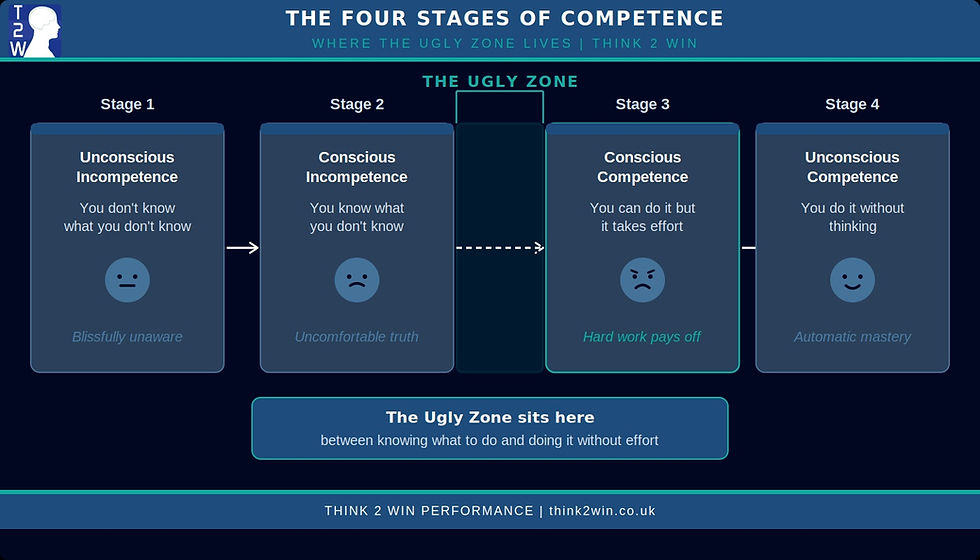
Most people are familiar with Noel Burch's four stages of competence: not knowing what you do not know, becoming aware of what you do not know, doing it consciously with effort, and eventually doing it automatically. What is less often discussed is the emotional experience of moving between those stages. Becoming aware of your own incompetence means realising, sometimes quite suddenly, that something you thought you were doing well, you actually were not. That feels like going backward. It is the first genuine step forward.
In my experience, the Ugly Zone sits most acutely between stages two and three: between knowing what you need to do and being able to do it without effort. This is where the work is hardest and where the temptation to revert is strongest.
Anders Ericsson's research on deliberate practice adds an important nuance here. The performance dip during skill acquisition is not random. It reflects the cost of redirecting attention from automatic processes to effortful, conscious ones. The best performers accept this cost because they understand it is temporary and purposeful. The short-term disruption is the price of a long-term upgrade.
The performers who struggle most are those who interpret the dip as evidence that the change is not working, when in fact it is evidence that the change has begun.
What the Ugly Zone Demands of You
If the Ugly Zone is unavoidable, and it is, then the question is: what does navigating it well actually require?
The first requirement is clarity of intent. You cannot tolerate sustained discomfort unless you are anchored to a clear reason for the journey. This is why the work I do always starts with understanding: who you are, what matters to you, and where you genuinely want to go. Without that anchor, the discomfort of the Ugly Zone feels purposeless, and purposeless discomfort is very hard to sustain.

But there is a point worth making here that gets missed in most conversations about purpose and motivation, and it goes further than the standard advice to find your why.
Simon Sinek's Start With Why made a compelling case for purpose as the foundation of sustained performance. Know your why, and the how and the what become far more manageable. That is true. But Sinek's framing treats purpose as something you find, fix, and then execute against. In my experience, that is rarely how it works in practice, particularly for people navigating genuine development.
Purpose shifts. Sometimes the Ugly Zone itself is what causes it to shift. You commit to a goal, you enter the difficult territory of changing to reach it, and somewhere in that process you discover that what you thought you were working toward is not quite what you actually want. The discomfort has clarified something. The friction has revealed a misalignment between your stated goal and your deeper values.
This is where Acceptance and Commitment Therapy's distinction between goals and values becomes genuinely useful. Goals are fixed endpoints: you reach them or you do not. Values are directions of travel: ongoing, evolving, and impossible to finally achieve. When someone loses attachment to a goal mid-process, that is not necessarily a failure of motivation. It can be a sign that their values have sharpened and the goal needs updating to match.
Deci and Ryan describe this as the difference between identified motivation, understanding intellectually why something matters, and integrated motivation, where the reason has been fully absorbed into your sense of self and genuinely becomes part of who you are. The Ugly Zone can accelerate that integration. People often come out the other side not just more capable, but clearer about why the work matters to them in the first place.
The practical implication is this: do not treat your purpose as either sacred or disposable. Hold it firmly enough to carry you through difficulty, but honestly enough to let it evolve as you do. The question to keep returning to is not why did I start this, but does this still reflect who I am becoming. If the answer shifts, that is not weakness. That is growth doing its job.
The second requirement is psychological flexibility: the capacity to hold difficult thoughts and feelings, the doubt, the frustration, the temptation to revert, without being controlled by them. The work of Steven Hayes in Acceptance and Commitment Therapy is instructive here. The goal is not to eliminate discomfort but to reduce its power to dictate behaviour. You can feel uncertain and still act in line with your values. You can feel less competent and still choose the harder, more purposeful path.
The third requirement is honest feedback. The Ugly Zone is a disorienting place and it is difficult to navigate without reliable external reference points. Left to their own judgement, people in the Ugly Zone tend to either overestimate their progress or catastrophise entirely. A trusted coach, mentor, or performance partner who can provide accurate and well-timed feedback is not a luxury at this stage. It is a genuine competitive advantage.
How Long Does It Take?
I want to be careful not to paint the Ugly Zone as a slow, grinding slog. It is not always that.
Sometimes development accelerates quickly. A shift in self-awareness produces rapid behavioural change. A single conversation unlocks a new perspective that reorganises everything downstream. Some clients move through faster than they expected because the foundation was already there and the work simply activated it.
But for most people, in most domains, the Ugly Zone takes time. Not because they are doing something wrong, but because real change at a deep level, the kind that holds under pressure and does not dissolve when circumstances get difficult, requires consolidation.
Phillippa Lally's research at UCL on habit formation found that genuine automaticity, the point at which a new behaviour becomes truly effortless, takes on average 66 days, and often considerably longer for more complex behaviours. The popular notion of 21 days is not just an oversimplification. It actively sets people up to abandon the Ugly Zone at precisely the moment they are closest to breaking through.
The question is never how quickly you can exit the Ugly Zone. It is whether you can stay in it long enough for the change to take hold.
What It Actually Feels Like From the Inside
Because the Ugly Zone is rarely discussed openly, people often assume their experience of it is unique to them, a sign of personal weakness rather than a universal feature of genuine development. So it is worth being direct about what it typically involves.
Reduced confidence, often in direct proportion to how capable you previously felt. A heightened self-consciousness where things that once felt natural now feel effortful and visible. Comparison to your previous self, the version who had it together, as if that version has become a standard you are now failing to meet. Occasional flashes of the new capability, followed by reversion to old patterns, which can feel more demoralising than consistent underperformance. And underneath all of it, the persistent question: is this actually working?
The answer, almost always, is yes. But you cannot see that from inside it.
This is why naming the Ugly Zone matters. Not as a clinical label, but as a reframe. When a client recognises that what they are experiencing is normal, expected, and a sign of genuine progress rather than inadequacy, something shifts. The discomfort does not disappear, but it loses its power to derail. They stop fighting the process and start working with it.
What to Do When You Are in It

The Ugly Zone is not something to manage around. It is something to move through, deliberately and with full knowledge of what it requires.
Name it. The moment you recognise that you are in the Ugly Zone, you have a choice: treat it as a crisis, or treat it as a stage. Naming it, even just to yourself, shifts your relationship with the experience from threat to navigation.
Return to your anchor. Why are you doing this? What is the specific outcome you are working toward, and why does it genuinely matter to you? When the discomfort peaks, this anchor is what keeps you in the process rather than out of it.
Measure process, not just outcome. In the Ugly Zone, outcome measures will often show no improvement or a temporary decline. That is expected, but it is demoralising if it is the only data you are looking at. Track your process instead: the consistency of your effort, the frequency with which you choose the new behaviour over the old one. These are the early indicators that change is building, even when results have not yet caught up.
Reduce the noise. The Ugly Zone is cognitively demanding. Anything that adds unnecessary pressure, over-analysis, excessive comparison with others, unsolicited opinion, drains the resource you most need to protect. Simplify your environment wherever you can.
Do not go it alone. Having someone alongside you in the Ugly Zone is not a sign of weakness. It is sound performance strategy. You need an honest external perspective when your internal one is most likely to be distorted.
Final Thought
The performers I respect most are not the ones who made development look easy. They are the ones who stayed in the Ugly Zone long e
nough to come out the other side.
The discomfort of genuine change is not a problem to solve. It is the mechanism through which growth becomes durable. The athletes and leaders who understand this do not waste energy fighting it or fleeing it. They recognise it, respect it, and use it.
If you are in the Ugly Zone right now, that is not something to be anxious about. It is something to be proud of. It means you are in the only place where real development actually happens.
Stay in it.


Comments